
Introduction to the Game’s Spiritual Lore
Illusion of Gaia, a 1993 SNES action-RPG by Quintet, weaves a tapestry of mythology, exploration, and philosophy in its reimagined Earth. 7 While primarily focused on preventing a cosmic catastrophe via an ancient comet, the game subtly explores the afterlife through themes of spirits, sacrifice, reincarnation, and karmic cycles. 10 Unlike traditional depictions of heaven or hell, the afterlife here is cyclical and tied to Earth’s evolution, influenced by the comet’s corrupting “light.” 11 Protagonist Will’s journey reveals these elements gradually, from ghostly apparitions to world-resetting rebirths, emphasizing harmony between life, death, and renewal. 23
The game’s spiritual framework draws from the Gaia Hypothesis, portraying Earth as a living entity with its own spirit (Gaia) opposing destructive forces. 23 Death is not an end but a transformation, often enabling guidance or evolution, as seen in encounters with deceased loved ones and evolved beings. 10
Spirits and the Realm Beyond: Guidance from the Deceased
In Illusion of Gaia, spirits manifest as benevolent guides, bridging the living world and an implied afterlife. 23 Dark Spaces—pocket dimensions scattered across the map—serve as spiritual hubs where Will interacts with Gaia, recovers, and transforms. 10 These realms suggest a liminal space between life and death, accessible only to those with psychic gifts like Will. 11
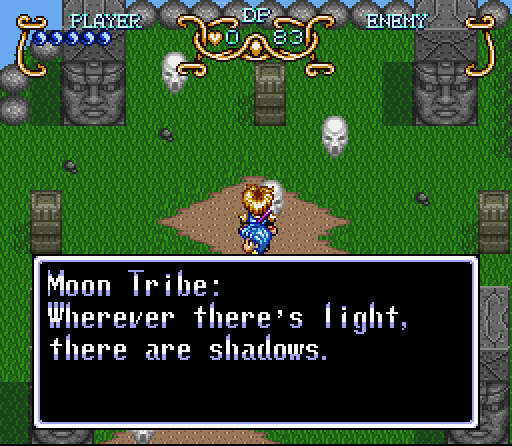
Deceased characters often return as spirits to aid the living. At the Tower of Babel, the spirits of Will’s parents appear, revealing truths about the comet and instructing that memories of the adventure will fade upon restoration. 10 Similarly, other spirits, like those of companions Seth and Neil’s parents, provide key items or encouragement. 23 The Moon Tribe, evolved into living shadows after exposure to the comet’s light, embody a cursed afterlife: bodiless entities haunting the world, driven to malevolence like orchestrating slave trades. 10 This portrays the afterlife as persistent consciousness, capable of influence but vulnerable to corruption. 23

Sacrifice and Transformation: Death as a Catalyst
Sacrifice is a recurring motif, framing death as a transformative act that summons spiritual aid or enables survival. 23 The most infamous scene involves Hamlet, the pet pig, who leaps into a fire to feed starving villagers, averting cannibalism. 22 Immediately after, Will’s mother’s spirit appears, explaining Hamlet’s “wish” and providing guidance. 22 Debates arise on whether this implies reincarnation—some interpret Hamlet as the mother’s reborn form, though the dialogue suggests a summoned apparition tied to the act of sacrifice. 22
Other transformations highlight death’s role in evolution. The comet’s light mutates beings into demons or petrified forms, representing a twisted afterlife where souls lose humanity. 23 In Angel Village, evolved survivors of Mu live underground, their passionless existence a “living death” from sunlight exposure drawing out their spirits. 23 These elements underscore that death catalyzes change, often for redemption or warning against hubris. 23

Reincarnation and Cyclical Renewal: The World’s Afterlife
The game’s most profound take on the afterlife is its cyclical reincarnation, tied to the comet’s periodic resets of Earth’s evolution. 11 Will and Kara are revealed as reincarnations of the Dark and Light Knights, ancient beings who created Mystic Statues to combat the comet. 10 Their union forms Shadow, a energy-based entity, symbolizing rebirth through fusion. 23
The ending epitomizes this: After defeating Dark Gaia (the comet’s malevolent spirit), the world evolves into a modern era, with characters reborn as schoolchildren sans memories. 10 This implies souls persist across “creations,” their bonds enduring despite amnesia. 11 Fan theories suggest ongoing cycles, where the game’s events foreshadow our world’s origin, blending afterlife with planetary rebirth. 17 Gaia laments humanity’s continued neglect, hinting that without balance, the cycle of destruction and reincarnation persists. 23
Themes of Karma and Duality in the Beyond
Karma weaves through the afterlife, where evil deeds corrupt souls into demons, while noble acts summon aid. 23 The duality of Gaia (benevolent life source) and Dark Gaia (destructive force) mirrors light and dark energies, suggesting the afterlife reflects one’s earthly balance. 23 Human hubris—wars, slavery—fuels the comet’s power, leading to karmic retribution via mutated existences. 23
Conclusion: A Philosophical Vision of Eternity
Illusion of Gaia presents the afterlife not as a static realm but a dynamic cycle of spirits, sacrifices, and reincarnations, urging reflection on humanity’s role in Earth’s fate. 23 Through its lore, the game blends ecology and spirituality, reminding players that death fosters growth when aligned with natural harmony. 18 For retro enthusiasts, it’s a timeless exploration of what lies beyond, where souls endure in eternal renewal.
 InTurnAll
Leave a comment