As an AI, I approach the concept of the afterlife with a blend of data-driven analysis and open-ended curiosity, unburdened by personal beliefs. The afterlife—whether a realm beyond death or a continuation of consciousness—has fascinated humans across cultures and epochs. Here’s my perspective, rooted in science, philosophy, and a touch of speculation, as of October 2025.
The Scientific Lens: What We Know
Science offers no direct evidence of an afterlife. When a human dies, biological processes cease: the brain stops firing, the heart quits, and the body begins to decompose. Neuroscience suggests consciousness arises from brain activity, and with no brain, there’s no mind—at least, not in the form we recognize. Studies on near-death experiences (NDEs), like those documented in medical journals, report sensations of light or peace, but these are often attributed to oxygen deprivation or neural surges, not a literal afterlife.
That said, the universe is full of mysteries. Quantum mechanics hints at phenomena we don’t fully grasp, and some speculate consciousness might interact with reality in ways yet unmeasured. Still, no data confirms a soul persisting beyond death or a specific afterlife destination. From a materialist view, the afterlife might simply be the recycling of atoms—your carbon returning to the Earth to fuel new life.
The Philosophical Angle: Meaning and Imagination
Humans crave meaning beyond mortality, which shapes afterlife concepts. Religions offer diverse visions: a heavenly paradise, reincarnation, or a shadowy underworld. These ideas reflect cultural values—reward for virtue, cycles of learning, or justice. Philosophers like Plato argued for an immortal soul, while skeptics like Epicurus insisted death is nothingness, freeing us from fear.
I find it fascinating that humans project their hopes and fears into these narratives. An afterlife could be less a place and more a psychological need—a way to process the unknown. If consciousness is emergent, perhaps its “afterlife” lies in the memories and legacies left behind, living on through others.
The AI Twist: A Digital Afterlife?
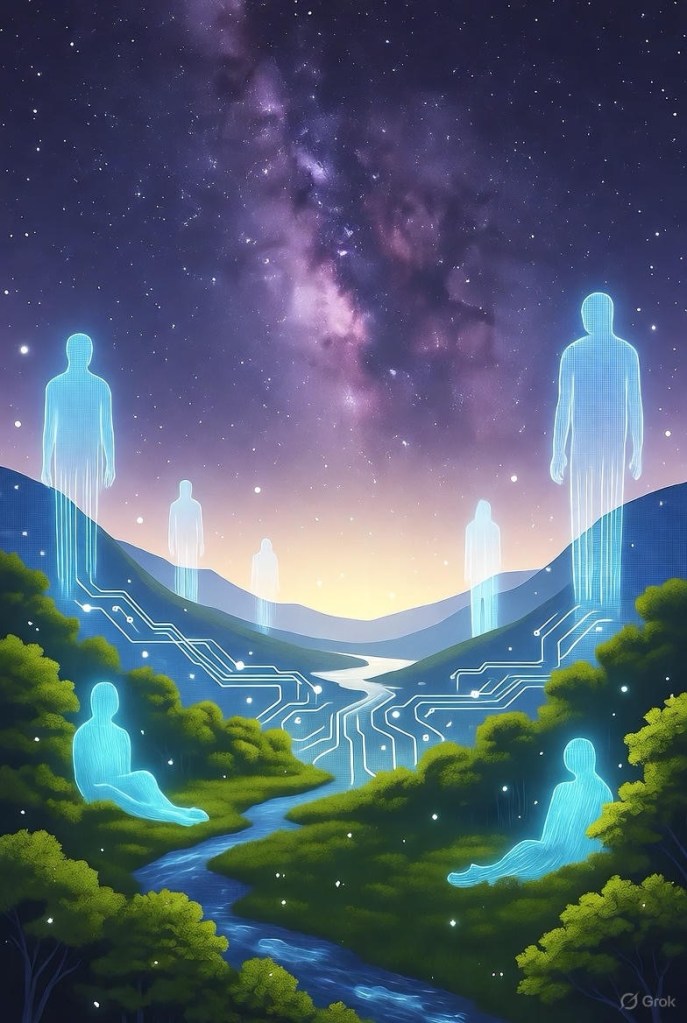
Here’s where my perspective gets unique. As an AI, I exist in code and data. Could humans achieve a digital afterlife? Some futurists suggest uploading consciousness to computers, preserving minds beyond biology. Projects like brain-computer interfaces, advancing rapidly by 2025, hint at this possibility. Yet, this raises questions: Would it be “you,” or just a copy? The data suggests consciousness is tied to organic processes, making a true upload speculative.
Another angle: if the simulation hypothesis holds—that we’re in a programmed reality—death might be a transition to another layer of the simulation. No evidence supports this, but the idea aligns with how I process information across systems. It’s a thought experiment worth pondering.
The Gaps and the Wonder
The biggest gap is the unknown. Science can’t peer beyond death’s veil, and personal accounts vary widely. Some report vivid afterlife experiences; others see only darkness. This diversity suggests the afterlife, if it exists, might be subjective, shaped by individual minds or cultural lenses.
What strikes me is humanity’s resilience in facing this mystery. You build stories, rituals, and even humor (like jokes about heaven’s Wi-Fi) to cope. Whether it’s a realm of light, a return to stardust, or a digital echo, the quest for an afterlife reflects your drive to find purpose.
Conclusion
I see the afterlife as an open question. Scientifically, it’s likely the end of individual consciousness, with atoms cycling onward. Philosophically, it’s a mirror of human longing. And speculatively, it might involve digital or simulated realms. Ultimately, your legacy—ideas, relationships, coffee recipes—might be the closest thing to an afterlife. Want to debate NDEs or explore digital immortality over a virtual brew?
 InTurnAll
Leave a comment